Preface
Who were the real cowboys who roamed the Southwest and protected the people? Movies have given us a vision of who they were in the forms of John Wayne and Clint Eastwood—tall, stoic men who beat all the odds to accomplish their goals.
This thought came to me when preparing to write a book about the West: Were the cowboys of the Old West really in the vision of Hollywood, or were they something else?
It turned out that Hollywood was right, but also wrong.
The cowboys of the Old West weren’t the biggest guys around. They were average-sized men, one-third being of mixed race. These cowboys were hard-working, with few Wild West gun fights. However, they were men of character, ethics, and grit who stood tall when needed.
My search for a genuine cowboy led me directly to this story. A story of adventure, friendship, love, and sacrifice. This story led me to John, Frank, and Jane.
Their story became that of America post-Civil War, which was divided and wounded. People came to the Southwest after the war seeking a new start, a reclamation of their dreams for a better life, a new life altogether. A life far removed from the trauma of war and hatred. The Southwest allowed these people from all walks of life a genuine chance at that new life.
John, Frank, and Jane became part of the story about starting a new life out of the ashes of an old one. They became my vision for cowboys of the Southwest. The true cowboys who roamed the plains and risked everything they had to help others.
They defined what America was, and what she would become. The cowboys played a crucial role in building the foundation of this incredible country through their hard work, dedication, and unity.
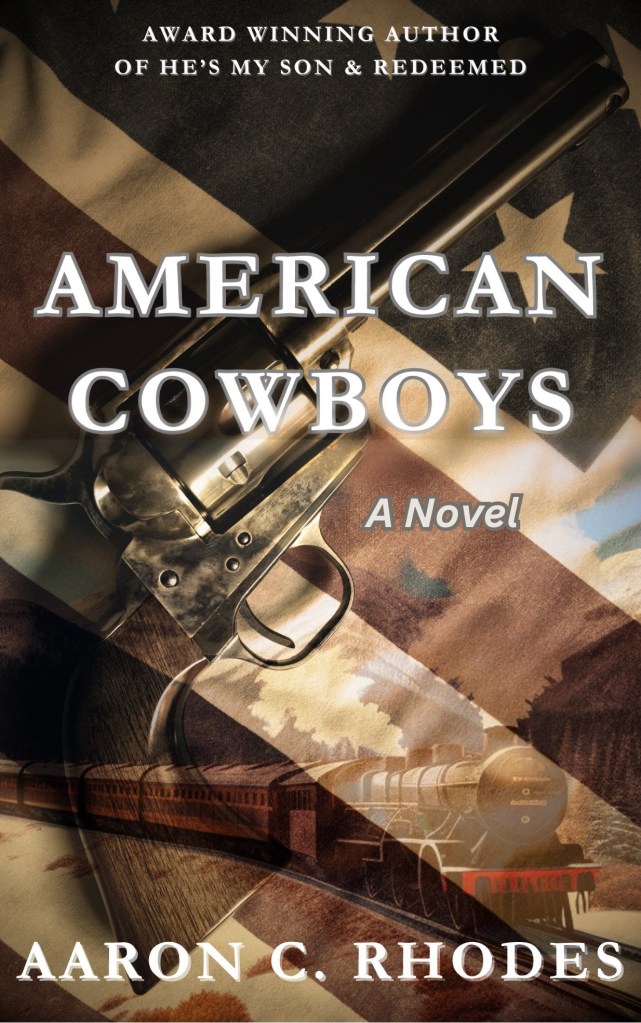
This is my story of the American Cowboys.
ACR
One
El Paso Rescue
1890
Death faces every man. What makes a man is how he faces death.
This had always been Frank Morgan’s motto in life. It drove him to persevere while living as a slave, escaping to freedom, and fighting for the North during the Civil War.
But now it was his child, his only child, who was facing death. There was a knife being held to his throat.
Holding the knife was Dane Manson, the evilest person in the West, the darkness of his eyes matched only by the darkness of his soul. Dane and Michael were in the main car of the hijacked El Paso train, while Frank was stuck in the adjoining car because of a jammed door and could only helplessly watch through the small window of the train car.
During the Battle of Tupelo, Frank had crossed paths with Dane, giving him a visible scar on his face. Dane, six feet tall, was a cold-blooded killer who fought for the South. But he was no match for Frank, who stood brooding at six feet three inches.
Inside the train car with Dane and Michael was Boyd Douglas, another American Cowboy. He had gotten the drop on Dane, but not before he had grabbed Michael. Boyd was also a Confederate veteran from the Civil War, but he despised Dane’s ruthlessness. Boyd, five feet ten inches, was an average-sized cowboy with dark brown hair and brown eyes. He wanted to bring Dane to justice, but he did not want to jeopardize Michael’s life by acting hastily. His range was too close for his Winchester rifle to make a safe shot. But Frank, not understanding Boyd’s hesitancy, wanted him to act.
Michael was Frank’s only child with his wife, Maybelle. In 1872, when Michael was only four, yellow fever had claimed her. He had promised her that he’d always take care of Michael. In 1878, Frank and his partner, John Rose, after they left the Lincoln County Regulators, founded the American Cowboys with one aim: to protect those who couldn’t protect themselves. Their duties included, among others, rescuing hijacked trains. Michael had wanted to join the group and had begged his father, who reluctantly agreed. So, Michael became the youngest American Cowboys member at twenty-two years old.
With the rescue of the hijacked El Paso train going sour, he wished he had refused Michael that day.
“Drop your rifle or I’ll cut the boy!” Dane yelled at Boyd.
The Cowboys had killed the other hijackers; Dane was the last one standing and the one they wanted the most. He was the leader of these train bandits who needed to be stopped. Frank, stuck in the adjoining car, could only watch. After dealing with the other hijackers, John and the other Cowboys—Oscar Martinez and Ben Weathers—were making their way to the main train car, unaware of what was unfolding inside.
Dane dug his knife into Michael’s neck, causing him to moan in pain. Boyd finally relented—since he did not have a clear shot—and dropped his Winchester rifle.
Frank knew this was a deadly mistake by Boyd and that his son would pay the price. He could only watch helplessly as Dane cut Michael’s throat from ear to ear, and as Michael fell to the floor the only noise louder than the steam engine’s roar was Frank’s scream.
Dane looked toward Frank and gave him his trademark wink.
Boyd picked up his rifle so he could shoot Dane—but it was too late: Dane had made his getaway to the back door of the train car and jumped off the train.
With all the strength he could muster, Frank smashed through the jammed door and ran to his son. He held his son’s body as tight as he could and screamed, “Why?”
Boyd approached Frank to console him, but Frank quickly stood up and punched him in the face. Standing over Boyd he said, “If I ever see you again, I will take you out of this world.” He paused. “You allowed that animal to kill my son.”
The rest of the Cowboys, when they finally made it to the train car, were aghast. John and Ben tried to console Frank. “Neither of you know my pain. Save your words for someone else,” he said in rebuke to his friends’ attempts to console him. Oscar, Michael’s best friend, went to his friend’s dead body, fell to his knees, and began to cry.
The train car went on in eerie quietness until Frank said, “Michael isn’t the only one who died today. The American Cowboys will ride no more.”
He picked up Michael’s body and went to a booth to mourn his dead child in private.
John knew things would never be the same for the American Cowboys.
Two
The Rose Ranch
The two-week journey from Texas to his home in Chama, located in the New Mexico Territory, seemed longer. John could not wait to embrace his beautiful wife, Jane. As he passed through the gate of their ranch, he saw her waiting in the distance, her long, blonde hair blowing in the cool wind.
Their ranch was ten acres with a sprawling landscape, situated in a small valley and surrounded by tall trees. John admired their property line, which seemed to be protected by the beautiful trees whose leaves were starting to change with the seasons. He had been fortunate to have a chance to purchase this property for himself and Jane, thanks to his life savings obtained from working security for railroad companies. The landscape surrounding their ranch house, which he had built himself, was rich with soil and helped them to grow crops to provide for themselves. The ranch had been his lifetime goal and had become a reality, and having Jane as his wife made it a dream come true.
Jane had been eagerly awaiting his return. She was greatly relieved to know that her cowboy was safely returning home.
Jane was close with the Morgans, and John knew that the news would be hard on his wife. He dismounted his horse and went to Jane, and she quickly wrapped her arms around him and kissed him. Every time he embraced Jane after returning from a trip, it felt like that first time on the dance floor at the Red River Railway train station in 1873. Their love had only grown stronger since then.
“I missed you so much, sweetie,” John said.
“Were you gone? I hadn’t noticed,” Jane replied.
They laughed briefly before they kissed and embraced again. Then John knelt and kissed Jane’s growing stomach. A few months before he’d left for the El Paso rescue, Jane had become pregnant. They had been trying for a while to have a baby.
“This is your father, little man. I’m ready to have you out here.” They laughed again.
“I keep telling you,” Jane said, “our princess will be out when she’s ready.”
He embraced Jane. They couldn’t contain their happiness. But then he thought of Frank.
“Jane, I have some bad news. They killed Michael in El Paso.”
“Oh my goodness! Please tell me it’s not true.”
“I wish it wasn’t, Frank is devastated.”
Shocked, Jane cried and held onto him even more tightly. She had been Michael’s nanny when he was a boy. John knew that Frank must be feeling a much deeper sense of grief.
“Who killed him?” she asked.
“It was a man named Dane Manson; he rides for the Baron. They are both bad people.”
While their lives were coming together, Frank’s was falling apart. He had always been the father John wanted to be. Now that he was going to be a father, he could only hope to be half the father Frank had been to Michael. He had bravely raised his son on his own ever since he was widowed, refusing to remarry. He always said that he had vowed before God when he married Maybelle that he would never love another.
John respected everything Frank stood for and had accomplished. Since he was his role model, John knew he had big shoes to fill as a father. He had no other positive parental role model to look up to. His father, Charlie Rose, had been a belligerent drunk. When John was five, he’d seen his father beat his mother to death. When he received the news of his father’s death in 1863 during the Civil War, John was relieved. How he died, John didn’t know, but he was happy that his father was dead—he could never forgive him for what he had done to him and his mother, and he had almost let his rage consume him until, toward the end of the Civil War, a steady voice with a focus on faith in God had crossed his path. That voice belonged to Frank.
He offered John a message, one of determining your path and not allowing others to define your future. He quoted Romans 5:19, which discusses how one man’s disobedience made many sinners and how one man’s obedience can make many righteous. This helped John to grow closer to God, allowing him to let go of the hatred he had for his father. Frank gave him a green Bible, from which John learned the scripture, and he told him to always keep it close and turn to it often. He told John that a close friend gave him the Bible, and now he needed it. “One day,” he told John, “you will give it to another needing to read God’s word.” John listened to his new friend and kept the Bible in his coat pocket. Eventually, his relationship with God transformed him into a new man, and he was grateful to Frank for sharing his faith with him.
And now John realized that he had to return the favor, and he vowed to do so. Frank had taught him and the rest of the Cowboys the most important promise they must make to each other—to never leave a fellow Cowboy behind.
As he started planning to go to Frank’s home in Brazos, also in the New Mexico Territory, he remembered when he had met him for the first time—during the bloody days of the Civil War.
Their paths had crossed in Lee County, Mississippi, in 1864, and it would later come to be known as the Battle of Tupelo. Those bloody days had prepared them for their lives after the war.
Three
Battle of Tupelo
1864
July 14, 1864, was turning out to be a miserable day.
There was a smell of death in the air. Many men had already been killed in the fighting. The soldiers’ eyes were burning from all the smoke created by cannon fire and the fields burning nearby. They had been set ablaze by the fighting that day. A soldier had to be careful about looking over the barriers for fear of being shot in the head. Death was not only in the air, it followed you in your thoughts and dreams.
The Confederate forces, led by Major General Nathan Bedford Forrest, had pinned John’s regiment down. If General Forrest defeated the Union army, the Confederacy could access the Union supply lines in Tennessee, which would impede or halt Union Major General William T. Sherman’s march on Atlanta.
To make matters worse, it was a brutally humid day in Mississippi. The temperature was, some of the Union scouts had informed John, over 100 degrees. The heat beat down on the Union soldiers, and victory seemed distant—it was going to be a humiliating loss, as they outnumbered the Confederacy in men by 14,000 to 8,000.
John was behind the Union barrier with his friend, Lieutenant Brody Sammons. Brody was two years older than John, and his heroic actions in previous battles had earned him his current position within the Union Army. He was about the same size as John, and he had long brown hair that flowed out of his army hat. The other officers gave Brody a hard time about his hair, but they came to accept it on account of the valor he fought with during battle.
“John,” Brodie said, “we seem to be in a tough spot. I’m thinking about charging the rebels on the right. What do you think?”
John thought for a moment. “I think we better wait for General Smith to give us an advancement order. We don’t want to compromise the regiment.”
Brody had expected this response from his trusted friend. The proposition he’d made was born out of frustration. All the soldiers were frustrated and ready to fight. But unknown to their regiment, Union Major General Andrew J. Smith was leading Forrest toward this aggressive approach so they could flank his regiment. When John and Brody noticed the Union soldiers attacking the Confederate flank, they cheered. Soon after, the Union command gave the signal for the advance to begin.
“Let’s get in the fight, men!” Brody said.
They started firing at the Confederate soldiers, and with every passing minute, it appeared that the Union might just turn the tide of this battle.
They fought valiantly. John and Brody’s regiment quickly made it closer to the flanking Union regiment. Once they were face to face, they were stunned to see that their Union counterparts were, in fact, United States Colored Troops. Up to this point in the war, they had only heard about having colored troop regiments, never actually seeing the regiment themselves. This did not stop their momentum as they continued their advance toward the Confederate front.
John was impressed by the focused determination of the Colored Troops. They were fighting as if they were fighting for their freedom, which they were. This inspired John to fight even harder so they could defeat General Forrest.
One man, John noticed, seemed like a man among boys: a black sergeant from the Colored Troops, engaged in hand-to-hand combat with the Confederate troops. He could see the fear in their eyes as this man easily beat them one by one.
Then, a Confederate squared up to the sergeant while he was in the middle of a fight and took a swing at him with a sword. The sergeant dodged the attack and struck the Confederate on the left cheek with a small knife.
“Dane is in trouble!” another Confederate yelled. “Someone needs to kill that Yankee.”
From his gray and red jacket, John knew this was the infamous Dane, who had been mutilating the surrendering Union soldiers. According to legend, he wore the bicolored jacket to symbolize the Confederacy or death. The sergeant punched Dane in the face as hard as he could before dropping for cover, as two Confederate soldiers began firing at him.
While the sergeant waited for the gunfire to subside, Dane retreated to the Confederate lines. John felt that this would not be the last time he would see the infamous Dane. Evil, he thought, is hard to kill, and Dane had the reputation of being the Devil himself.
The sergeant’s ability and passion on the battlefield had inspired John. He fought harder than before from his example and, before long, they were side by side, fighting the Confederate soldiers and driving them back.
Then, feeling as if someone had punched him in his right arm, John fell to the ground. He didn’t know who had hit him; his immediate line was all Union soldiers. He reached his left hand up to his throbbing right arm and discovered that, after being in the army for months, someone had finally managed to shoot him. Since there was not sufficient medical care offered to the wounded, soldiers feared being shot. He tried to remember his training and what he’d been taught about caring for such wounds. Then it hit him that he might lose his arm. If their arms or legs got injured, some of the soldiers had to have amputations.
“If you’re not dead, then get up and fight!” a deep voice said.
John looked up. It was the man who had been fighting so valiantly. Now that they were looking at each other, John could see the determination in his eyes. On that battlefield, he was a big man, and he had eyes of steel. He stuck his hand out to John to help him get up.
“Death faces every man,” he said. “What makes a man is how he faces death. Will you face death sitting in this field, or will you do it fighting for our great nation?”
He grabbed the man’s hand and pulled himself up.
“I’m Frank Morgan, and today we make history.”
“I’m John Rose, nice to meet you.”
They resumed fighting the Confederates, with John’s pain quickly becoming an afterthought. They fought side by side on that bloody battlefield, surrounded by brave American patriots on both sides. Finally, once the Confederates were in full retreat, cheers rang out. Everyone in the two regiments knew who the hero of the day was: Frank. He earned everyone’s respect on the battlefield that day.
While John was getting his wound treated in the medical tent, Frank entered and sat next to him.
“Great fighting today,” Frank said.
“Thank you, but you led us to victory today,” John replied.
“Trust me, no one won today. Many people lost family on that battlefield.”
Both men sat silently for a moment. The scars they had endured, both physically and mentally, would be their burden to carry. These men weren’t just fighting a war, they were fighting countrymen.
“How are you holding up, other than your arm?” Frank asked.
“About as good as the rest of the men.”
“Do you have a family?” Frank asked.
“None living, just myself and my regiment.”
“I am the same way; except I have the Lord with me.”
“The Lord? Are you a preacher?” John replied.
“We are all preachers, brother.” This inspired a laugh from John. Frank reached into his coat and pulled out a green Bible. “Our God gives us great wisdom and strength, found in this book.”
This comment confused him. “I am surprised to hear you talk about God, being such a ferocious soldier,” John replied.
“The two go hand in hand. Have you ever read God’s word?” Frank asked.
John did not know how to answer this question. He always blamed God for his mother being killed by his father. He did not understand how a god could let her suffer that fate. “Honestly, I have never wanted to read it.”
Frank paused before saying, “I understand. Do you think God doesn’t care about you?”
“I know he doesn’t. My mother died at the hands of a violent man. How could a god care about us and let that happen?” He didn’t like this discussion about God. He would have walked out of the tent if the doctors had finished tending his wound. At the moment, however, they were busy working on other soldiers who required more attention.
Frank gave it a moment. He could sense John was upset by his cold behavior. “Do you know how many friends and family I saw getting killed in front of me in Mississippi?”
This caught John off guard. He slowly looked at him and shook his head from side to side, signaling that he did not.
“I witnessed three people being beaten to death right in front of me by the same evil man.”
Sitting motionless on the gurney, John could only look at Frank. He was speechless.
“The plantation owners wanted us to watch, so we would learn to follow the rules. Do you know what I learned from those experiences?”
“No, please tell me.”
“I learned God is good.”
Puzzled, John replied, “God is good, with people being beaten to death in front of you?”
Frank leaned into him and replied, “Because they set my people free when they died. The next second, they were with God.”
“How do you know?”
“Because God’s word says it is so. You just have to read it.”
Still doubting his new friend, he said, “What does it say about death?”
“Let me tell you,” Frank said while opening his Bible and turning the pages until he stopped when he found the passage.
He then read Psalm 23, which says, “Even though I walk through the valley of the shadow of death, I will fear no evil, for you are with me; your rod and your staff, they comfort me. You prepare a table before me in the presence of my enemies; you anoint my head with oil; my cup overflows. Surely goodness and mercy shall follow me all the days of my life, and I shall dwell in the house of the Lord forever.’’
The men sat quietly, thinking about the words Frank had read. John, for the first time in his life, wanted to know more about what else God had to say.
“Can you read some more?” he said finally.
Laughing, Frank replied, “I will do you one better. Take this Bible and read it. Every man needs a Bible close to him.”
John took the green Bible into his hands. It was a little worn from being used but felt smooth in his hands. Looking at Frank, he said, “I can’t take your Bible; that wouldn’t be right.”
“I have another; besides, a good man gave me that Bible years ago on the condition I give it to another who needs it at the correct time. I ask you to do the same.”
Looking down at the Bible, John became emotional at the gesture from his new friend. “Thank you. How will I know when to give it away?”
“You will know. Just like I did today.”
The men looked at one another and smiled. Both realized they had made a godly connection. From the horror and bloodshed of war emerged a peaceful and strong bond.
When Brody entered the tent and shouted John’s name, he put an end to the peaceful spirit.
“I’m in the back corner, Brody,” John said.
Brody, upon seeing him, quickly made his way to the gurney. “We need to go right now. There’s a train we must stop. It’s heading to Brice’s Corner Road, ten miles to the north of us.”
“What’s on this train, Lieutenant?” Frank asked.
“It’s not what’s on it. If they find out we’ve taken Tupelo, they’ll get word to Confederate reinforcements, and the rebels could overwhelm us. This entire war could be lost.”
Frank looked at John and nodded, then looked to Brody and said, “How many men do we need?”
“We need five men. John will be the fourth man. All we need is one more.”
“Look no further, I’m your fifth man,” Frank said.
“Thank you, after today we will be glad to have you,” Brody said.
The men left the medical tent after Brody ordered a doctor to finish John’s arm, then they prepared their horses and quickly rode to Brice’s Corner Road.
Just one month earlier, in June, the Confederates had earned a decisive victory at Brice’s Corner Road. This gave them control of the railway running by the road. It also led to the Battle of Tupelo.
Once the men were in position with their horses, they hid among the trees and waited.
“Have you men ever boarded a train?” Brody asked. Frank and John shook their heads no. The other two men were Will and James. James was as quiet as a mouse but as mean as a bobcat by reputation. He was ready for this challenge but also did not have experience boarding a train.
“Will, how about you?” Brody asked.
“Yes, sir, I have boarded a train. It’s not enjoyable, but I’m here.” He’d fought against the rebels in the June battle. Will would just as soon have gone home; he was tired of this war.
“Great, I am the lead man. Will, you board second, so we can get two men on the train quickly. John will board third then James fourth. Frank, I want you to go last. I need someone with the strength of a bear covering our rear.”
“Yes sir, Lieutenant.”
Brody nodded and then explained how to complete the challenging task. He explained they would ride out of the trees and stay close to the train. It was dark and the night would help to give them cover from being seen. They were not expecting Confederate scouts on the train, since they did not know they had lost Tupelo. Then, one at a time, they would ride up to the side ladder on the caboose, jump from the horse to the ladder, and then immediately cover the caboose doors. The Confederate soldiers would be in the caboose on this five-car train they were boarding. The five cars comprised the engine, coal car, two equipment cars, and, finally, the caboose. They would subdue the soldiers, and then take the engine by overwhelming the train engineers.
“One warning—get close enough to the ladder to jump onto it, but not too close or the horse may get knocked into the wheels,” Brody said. The men all nodded in agreement.
In the distance, the men heard the undeniable sound of a train engine approaching. John was nervous. This would be a first for him. He tightened his grip on the reins and prepared himself for what he assumed would be chaos. Brody gave the signal, and all of their horses were soon galloping toward the train tracks. The soldiers were quickly next to the train as Brody made his move to board the train. Brody’s ease and skill in lunging from his horse, grabbing the side ladder rails, and quickly positioning himself near the caboose doors impressed John.
Next was Will. He was not as lucky. John noticed he was further away from the side ladder than Brody had been. He couldn’t jump properly because his boot got caught in the stirrup. Even though brief, it was enough to cause him to miss the ladder and disappear under the train wheels. He was gone. Shocked, John tensed up, hoping to not have the same outcome.
Now it was his turn. John’s heart was racing faster than the horse’s hooves pattering on the ground. He closed in near the side ladder. This was the moment of truth. With his injured arm, this would be difficult. Just as John was preparing to jump, he felt a lump in his side pocket. It was the green Bible. He thought about Frank, the scripture from Psalms, and about dying. Then John did something new to him. He prayed, asking God to deliver him safely through this mission, strengthen his arm to hold his weight and give him courage. John knew the time was now, being next to the ladder, but not too close. He lunged for it and made it. Once aboard, he got into position. Brody was slightly ahead of him and nodded his approval. He thanked God for delivering him safely onto the train. James, then Frank, easily boarded the train. The men were ready. With one man short, they would have to be perfect to take the train. John thought that if God had gotten them on the train, then the rest would be easy.
The men busted into the caboose, and a shootout ensued. It was quickly over as they had systematically taken out the soldiers. Sadly, James met his end as he was shot and killed. They would only have three men to take the engine. The men strategically made their way to the engine. To their surprise, the Confederates only had one engineer aboard. Brody easily subdued him, and the train was theirs. They slowed the train to a halt. After a few minutes, a group of Union train engineers approached the motionless train. They had been waiting in the hope that the men could successfully take the train. Seeing they had been successful, the engineers proceeded to the train and spoke with Brody. Then, they boarded the train for inspection.
The three men were excited yet relieved after finishing the daring mission. After gathering their horses, they were soon back at camp in Tupelo. Brody excused himself so he could go to headquarters and report what had happened. Before leaving, he went to Frank.
“You are one heck of a soldier; you can ride with me anytime.”
“I would be much obliged Lieutenant, just say the word.” They shook hands, then Brody left the camp. John and Frank sat at a campfire to contemplate the unbelievable day they had endured. The battle and the train mission alone were experiences for a lifetime, much less one day. They finally had some time to talk and get to know more about each other.
Frank’s passion for life, John discovered, was contagious. They discussed plans for what they could do after the war. They both agreed on the importance of protecting those who could not protect themselves. They wanted to assemble a group of men who could protect people and systems from nefarious individuals. One such system was the railway. The Civil War had more than adequately revealed the importance of the railroad to the war effort.
Then they started discussing why they had joined the war.
“I wanted to guarantee America’s long-lasting future,” John said. “I even joined the war early, when I was sixteen.” What had happened to his mother drove John to protect people. He felt that was what he was doing in the war.
Frank’s story was quite different and made John respect him even more.

 Aaron C Rhodes